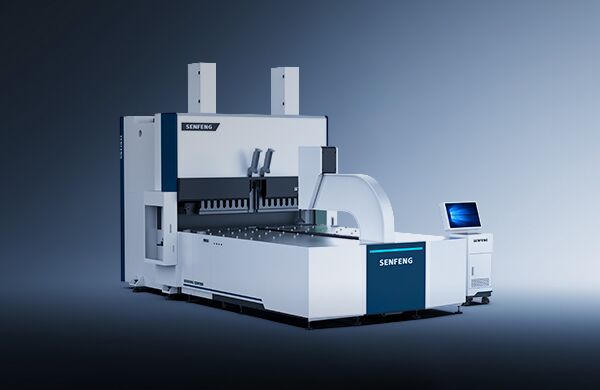
Within the industrial production chain, where every step must be carried out with maximum precision and efficiency, there is a category of equipment that is critical to almost every metalworking plant: bending machines. These machines, which enable precise processing of metal plates, profiles and tubes into customized shapes, serve as an essential basis for the production of metal products of all types – from electrical cabinets, through lighting fixtures to heavy steel structures. But as with any machine, here too the element that determines the quality of work, performance and reliability is the part that is in direct contact with the raw material – the tools. Tools for bending machines are in fact the “beating heart” of the bending system, and a thorough familiarity with them is essential for everyone involved in the process – production managers, engineers, technicians and maintenance personnel.
What are bending tools and what is their role in the machine?
A bending machine is usually a hydraulic or electric machine that includes pistons and control mechanisms, the purpose of which is to apply controlled pressure to a piece of metal in order to change its shape. This operation is carried out by two main components: the punch, which is the upper tool, and the die, which is the lower part. Together, these two tools create a pressing movement that causes the metal to bend at the desired angle and shape. Tools for bending machines come in a huge variety of sizes, angles, geometries, and compositions. They are often made of hardened steels or wear-resistant alloys, and are designed to withstand enormous pressures over time. Matching the right tool to the type of material, its thickness, and the desired bending shape is a process that requires knowledge and experience, and often trial and error. The higher the accuracy required – for example, in the electronics or automotive industries – the greater the importance of the right tool.
Matching the tool to the material
One of the main challenges in metal bending work is the great variation between the types of materials. Aluminum, regular steel, stainless steel or special alloys – each material reacts differently to pressure and bending. A bending tool that is not properly adjusted may cause damage to the product: cracks, wrinkles, deformations or even breakage of the material. Therefore, when choosing tools for bending machines, parameters such as:
– Material rigidity and flexibility
– Board thickness
– Desired bending radius
– Accuracy requirement
– Is single-sided or multi-stage bending required?
Moreover, correctly calculating the required pressing force and combining it with the appropriate tool not only prevents defects – but also preserves the longevity of the tools and the machine itself. This is an element that is often neglected, but is critical to both the quality of the result and long-term maintenance costs.
Innovations and updates in the field of tools
The field of bending machine tools is not static. On the contrary – in recent years, there has been significant progress in the manufacturing technologies of the tools themselves. Whether it is developments such as tools with internal cooling, new materials that combine strength with lighter weight, special coatings that prevent wear or quick tool-changing systems – all of these indicate a real development in a field that was previously considered “mechanical” and static. Alongside the developments in raw materials, there is also a noticeable trend of connecting digital technology with the world of machines. Today, quite a few of the tools imported by Everest come with identification sensors, the ability to automatically adjust the position according to the machine’s operating software, and direct connection to quality control systems. Such a combination makes it possible to make immediate adjustments, identify anomalies in real time and maintain uniformity in the production process – even in large-scale projects.
Importing tools – the importance of quality and local adaptation
One of the main specializations of professional companies in the field is in the customized import of tools for bending machines. Since this is a precise and multi-impact equipment, it is very important to ensure that the tool is suitable not only for the type of machine but also for the specific type of production. Not every tool manufactured in a factory in Europe or the Far East is suitable for the conditions and expectations of customers in Israel - therefore, the importing company has a critical role in bridging the gap between the tool supplier and the customer's needs. A company that also specializes in the repair of industrial machines in general, and bending machines in particular, knows how to address the big picture - not only to adjust the tool, but also to ensure that the overall functioning of the system remains proper. Quite a few malfunctions that originate from inaccurate or worn tools lead to the slowing down of the entire line, wasting raw material and unnecessary operating costs.
Need smart, high-quality tools? Everest Import Machinery is the address you're looking for. Contact information is available for you here on the site.